
⚖️ Accountability Isn’t Just Personal—It’s Cultural
If you’ve followed along on this blog, you already know how much I believe in resilient leadership, authentic presence, and leading from within, regardless of title. But there’s another truth that’s just as powerful:
Even the most self-aware, motivated people can get stuck when they’re in a culture that promotes the wrong kind of accountability.
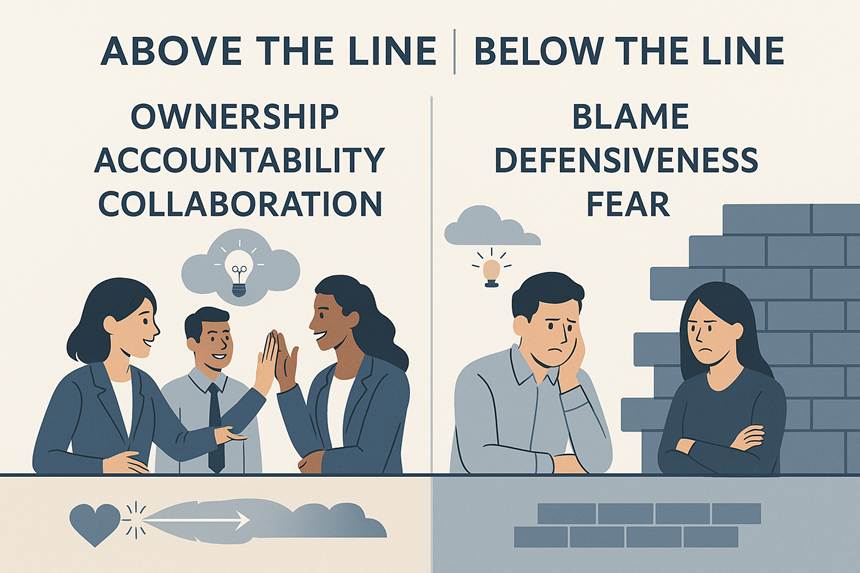
This is where the concept of Above and Below the Line comes in—first introduced in The Oz Principle by Connors, Smith, and Hickman. If you haven’t read it, I highly recommend it. It’s full of exercises and ideas that are especially useful for teams trying to build a culture of trust and ownership.
So what does “Above the Line” really mean?
🔼 Above the Line vs. 🔽 Below the Line
Above the Line accountability is grounded in:
- Ownership
- Collaboration
- Curiosity
- Solutions
- Shared responsibility
It’s the kind of environment where people speak up, learn from mistakes, and support each other’s growth.
Below the Line accountability, on the other hand, is rooted in:
- Blame
- Defensiveness
- Fear
- Covering mistakes
- Compliance over contribution
This is where innovation stalls, trust erodes, and growth becomes secondary to survival.
👩🏻💻 Two Stories, Two Cultures
Let me bring this to life with two real examples from my career:
🟢 The Agile QA Team: Above the Line
In my first role as a Quality Analyst on an agile team, our culture encouraged openness and trust. We were taught to enter defects with as much detail as possible—not to blame, but to help the developers understand the user experience and collaboratively solve the problem.
Performance wasn’t judged on “who got it wrong,” but rather how the team responded, learned, and improved together. That mindset made it safe to speak up and created an environment of shared success. Everyone was motivated to do things the right way—because we were accountable to each other, not afraid of one another.
That’s Above the Line in action.
🔴 The Second Company: Below the Line
Fast forward to a new company. A few weeks in, I found a defect and did what I was trained to do—entered it in the system. What followed? Panic.
“Why would you do that?”
“You don’t report a defect without checking with the developer first!”
It wasn’t just odd—it was shocking. I later learned that developers were rated based on how many defects were opened against them.
Suddenly it made sense. The culture had trained people to protect themselves—not improve the product. Everyone wanted to get it right, but they were also working around the process to avoid being punished for doing the work.
That’s Below the Line. And it breeds fear, resentment, and surface-level compliance.
💬 Why This Matters for Resilient Leaders
We’ve talked throughout this series about:
- Knowing who you are
- Building your brand
- Leading without a title
- Practicing continual growth
- Showing up with intention
These personal foundations are what allow us to lead even when the culture isn’t perfect. Because let’s face it—sometimes the storm is bigger than us. But one steady light can start to shift the tide.
When you operate Above the Line, you give others permission to do the same.
Over time, this creates a ripple effect. It inspires team trust. It sets new expectations. It helps change the conversation from “who messed up?” to “how can we make it better together?”
🛠 How to Lead Above the Line (Even When the Culture Isn’t)
- Model It Yourself
Own your part, speak with curiosity, offer solutions—not blame. - Stay Consistent
Even if others operate defensively, your consistency builds trust and credibility over time. - Acknowledge the Culture—but Don’t Feed It
If the current culture punishes openness, recognize it—but choose your actions intentionally. Find allies. Start small shifts. - Recognize the Triggers
Below the Line moments often come from fear. Learn to spot the defensiveness in yourself or others—and ask, “What’s really at stake here?” - Keep Showing Up
Your presence is powerful. Even in tough spaces, how you show up can be the beginning of something better.
🧩 Final Thought: One Light Can Shift the Room
Culture can either crush accountability—or elevate it. And while you may not be able to change the entire culture overnight, you can change your corner of it.
Your awareness, your actions, your consistency—these are leadership in motion.
And just like resilience, Above the Line leadership is contagious.
So ask yourself:
Am I showing up above or below the line today?
And what ripple could I create by choosing the high road—even when it’s hard?
📚 Resource Mention:
Explore The Oz Principle by Connors, Smith, and Hickman for deeper insight on Above/Below the Line thinking and how to bring it to your team.
 Authentic Evolution Journey