Building Bridges, Not Walls: Relationships That Shape Success


🌉 Why Relationships Matter More Than We Think

In my early career, I kept my head down, did the work, and believed that results alone would earn me success.

And while hard work is absolutely important, I’ve learned something even more powerful: the right relationships can accelerate your growth in ways that hard work alone never will.

Some people see relationships as transactions. I see them as bridges, built over time, connecting you to opportunities, perspectives, and support you never knew you needed. The stronger the bridge, the more it can carry you through both difficult and good times.


📖 Story #1: The Mentor Who Changed My Trajectory

About five years in at a previous employer, a new CIO joined the business. In one of his first leader roundtables, I asked a question I thought was important:

“What’s your vision or plan for the future based on what you’ve seen so far?”

A few people around the table gave the usual side comments—dismissing the question instead of engaging with it. The CIO didn’t acknowledge their remarks. Instead, he answered my question as directly as he could with the knowledge he had at the time.

That small moment caught my attention.

A few weeks later, he sought me out to ask more questions. I kept my guard up and gave him the “safe” answers. But he read me like a book—he knew I had insights I wasn’t sharing yet, and that trust had to come first.

His awareness, his ability to listen between the lines, and his emotional intelligence created an instant professional connection. He was serious about his job and equally serious about creating a culture where people’s voices mattered.

Months later, I asked if he would be my mentor. He agreed. That mentorship became one of the main reasons I grew into a stronger, more confident professional—and eventually a mentor myself.


📖 Story #2: My “Why” for Sports and Community

My love for fostering community didn’t start in the workplace—it started with my mom’s best friend, Mimi.

Mimi was a force. She was head of the booster club for our school sports, on the school board, always at games, and constantly helping at events. She also happens to be the reason I fell in love with my favorite college basketball team (and no, I’m still not telling you who they are).

I started volunteering to help her with events, selling tickets, running concessions—anything that needed to be done.

What I didn’t realize at the time was that she was teaching me values that would shape my approach to life and leadership: showing up for your community, investing your time and energy into people and causes you care about, and leading by example.

To this day, those early experiences are a big part of why I continue to play volleyball, support the volleyball community, and build spaces where people feel connected and supported.


✅ A Checklist for Nurturing the Right Relationships

Over the years, I’ve found there are a few non-negotiables for building and maintaining both personal and professional connections:

  1. Values Alignment – You don’t have to agree on everything, but the core values need to match.
  2. Consistency – Trust is built through reliability, not grand gestures.
  3. Support Over Judgment – Feedback is important, but the foundation should be encouragement, not criticism.
  4. A Two-Way Street – Both people give, both people benefit.
  5. Reevaluate as Needed – People grow and change. So should our relationships.

🌱 Final Thought

The relationships that shape us aren’t always the ones we expect. Sometimes it’s a formal mentor. Sometimes it’s a friend, a coach, or a community leader who plants a seed that grows for decades.

The key is to be intentional about building bridges instead of walls—connecting with people who challenge you, support you, and help you grow into the best version of yourself.

When we surround ourselves with the right people, we don’t just reach our goals faster … We enjoy the journey more along the way!


Reset Without Losing Direction

Photo by Jose Antonio Gallego Vázquez: https://www.pexels.com/photo/road-landscape-art-street-2777776/

🧭 Pivoting Without Losing Your True North

One of the biggest lessons I’ve learned, both in my career and personal life, is that sometimes the path we thought we’d take isn’t the one we end up walking.

The ability to pivot isn’t a sign of failure or weakness. It’s a sign of awareness, courage, and trust in yourself.

For years, I clung to the belief that success meant picking a path and sticking to it no matter what. That staying the course was the only way to “win.” But life has a way of showing us that adaptability is just as important as perseverance.


📍 My Compass Moment: The Job Change

If you’ve read my post on Trusting the Compass, you know this story.

My company was moving their headquarters to New Jersey. On paper, the “safe” decision was obvious. Accept the relocation package, keep the stability of my role, and continue on the path I was already on.

But my heart was here. My life was here. My people, my volleyball community, more sunny days, and the sense of home I had worked hard to build.

I could play it safe, or I could take a risk.

I followed my gut. I trusted the foundation I had built: my skills, my work ethic, my marketability. I put in the effort and ended up exactly where I was meant to be.

That’s the thing about pivoting, it’s not abandoning your goal. It’s adjusting the path while keeping your destination in mind.


💔 The Relationship Crossroads

The same is true in personal relationships.

There are moments where things feel stuck or tense, and it’s tempting to react quickly—either by checking out emotionally or walking away entirely.

This is where a “pivot framework” comes in handy. When you hit those tough points, step back and ask:

  1. What was my original goal or expectation?
  2. Are my morals, values, and needs still aligned here?
  3. Is the difficulty we’re facing a temporary obstacle we can work through, or a fundamental difference in direction?

Sometimes the answer is to persevere and work through it. Sometimes it’s to move forward separately. Either way, you’re making a conscious choice that aligns with your true north.


🛠 A Framework for Pivot vs. Persevere

When deciding whether to pivot or push through, I use these five steps:

  1. Revisit Your Why
    Why did you start this job, relationship, or goal in the first place? Does that still hold true?
  2. Assess the Current Landscape
    What’s changed? Are these changes within your control?
  3. Evaluate Alignment
    Do your morals, values, and long-term vision still match the path you’re on?
  4. Consider the Cost of Staying vs. Changing
    What will it cost…emotionally, mentally, financially; to keep going as is? What would it cost to pivot?
  5. Decide with Intention
    Whatever you choose, own it fully. Move forward with purpose, not regret.

🌱 Letting Go of Perfection

One of the most freeing realizations in my life has been letting go of the idea that a pivot means starting over.

Adjusting your goals doesn’t erase the progress you’ve made, it builds on it. Every step, even the detours, has something to teach you.

When we stop clinging to the need to get it “perfect,” we give ourselves space to grow, to adapt, and to discover opportunities we might have missed otherwise.


✨ Final Thought

Whether you’re at a career crossroads, in a relationship shift, or reevaluating personal goals, remember this:

Your destination may stay the same, but the road there will almost always have turns you didn’t expect.

The power of the pivot is knowing when to change direction without losing sight of who you are and what matters most.


I Shanked It: Resilience Lessons from the Volleyball Court


🏐 I’m Sure I’ve Mentioned I Play Volleyball… Once or Twice

Okay, probably more like a hundred times. (If we’ve ever had coffee, I’ve probably brought it up before your latte even cooled.)

But hear me out—sports and careers really do share a lot of the same lessons. It’s part of why people say organized sports are so good for kids. The court, just like the workplace, is a training ground for resilience, teamwork, and learning from mistakes.


🌊 Grace Bay, Turks & Caicos — The Shank Lesson

In volleyball, a bad pass is called a shank—a wild, off-target mess your partner may or may not be able to save. Defense is everything. If you can’t make a solid receive, your chance of making a great play drops fast.

When tournaments get intense—especially near finals—I sometimes hit a “serve receive slump” and can’t pass a ball to save my life. That’s shanks, plural. Failure, plain and simple.

On one trip to Grace Bay, I met a sports psychologist named Dr. J. I told him my problem. He spotted it right away: I was forcing an outcome instead of playing in the moment. I wanted the win so badly that I stopped relying on the basics I already knew—move my feet, get to the ball, make the play—and started overthinking every move.

Dr. J gave me tools to ground myself, and now when those slumps happen, they don’t go nearly as deep.


🏆 AVP Grass Nationals 2022 — The Small Win Lesson

In October 2022, my partner and I won our division at AVP Grass Nationals in Chattanooga, TN. We were thrilled—until the comments rolled in:

“It was only B division.”
“There weren’t that many teams.”

Sure, those things were true, but here’s what else was true:

  • We worked hard to get there.
  • We had no block, no jump serve, and I was the primary hitter on a men’s height net.
  • We fought for every point and outplayed every other team in our bracket.

We accomplished something, and no one gets to take that away.


💡 What It Means Off the Court

Whether you’re in the workplace or on the court:

  • Don’t let anyone take away from your small wins. Success is relative, and it’s worth celebrating where you’re at.
  • Learn from your shanks. Mistakes are data. They’re proof you tried, and they teach you how to be better next time.
  • Stay present. Wanting the outcome too badly can trip you up. Trust your skills, your training, and your instincts.

When you shank it—at work or in sports—don’t spiral. Learn, reset, and play the next point stronger.

And if you want to learn more about the mental side of sports and performance, check out Dr. J’s Instagram here:
Mind Right Sport Psychology

Trusting the Compass: Letting Your Values Lead

Photo by James Wheeler: https://www.pexels.com/photo/photo-of-pathway-surrounded-by-fir-trees-1578750/

🧭 Following Your Own North Star

There’s a certain comfort in playing it safe.
The steady paycheck.
The predictable move.
The path that everyone expects you to take.

But here’s the thing:
Playing it safe isn’t always what’s best.


💬 The Choice That Tested My Compass

Years ago, my company announced it was moving its headquarters to New Jersey. They wanted me to relocate.

It would have been the smartest and safest decision to say yes:

  • I had a stable job.
  • They were covering relocation.
  • It was the “logical” next step.

So, what was there to think about?

Everything.

Why?

Because my heart wasn’t in New Jersey.
It was here.
The place where I have built a life I love, a strong community, friends who are like family, sunny days that recharge me, and a wonderful volleyball community that feeds my soul.

I could choose safety, or I could choose risk.


⚡ Choosing Risk & Myself

I followed my gut. I stayed.

Not because I was reckless, but because I trusted the foundation I had built:

  • I knew I was marketable.
  • I knew my skills had value.
  • I knew I was willing to put in the work to find the right next step.

So, I bet on myself. And you know what?
I landed exactly where I was supposed to.


🧠 Why Trusting the Compass Matters

We spend so much time building our skills, networks, and reputation. But when it’s time to make a big decision, those things only matter if we trust them enough to act.

Whether it’s:

  • A job change
  • A move
  • A tough relationship decision
  • Or any fork in the road

The safest route may keep you from failing, but it can also keep you from growing into your best self.


🔑 How to Strengthen Your Inner Compass

1. Know Your Values
Be crystal clear about what matters most to you – both personally and professionally. This becomes your decision-making filter.

2. Build Your Foundation Before You Need It
Keep growing your skills, nurturing your network, and strengthening your reputation. When opportunity or change comes, you’ll be ready.

3. Listen to Your Gut, Check the Facts
Intuition is powerful – but pair it with what you know to be true about your abilities, resources, and options.

4. Be Willing to Bet on Yourself
If you can’t trust yourself to make the leap, it’s time to do the work so that you can.


🌱 Final Thought: The Compass Is Useless Unless You Follow It

It’s one thing to have values. It’s another to live by them – especially when they lead you away from the “safe” choice.

If the foundation you’ve built is strong, you can trust it to hold you – through risk, change, and uncertainty. And if you realize it’s not strong enough? That’s your cue to start building now.

Because the real danger isn’t taking a risk – it’s ignoring the compass that’s been pointing you toward the life you’re meant to live.

One Foot in Front of the Other: A Moment for Grace and Realignment


🌿 Progress Over Perfection—In Work, in Grief, in Healing

At the end of the last post, we talked about the idea of progress over perfection. And as I sit here now, writing this, I realize it’s time to share something more personal—because this lesson has been living inside of me for the past several months.

One of the reasons I started this blog—Authentic Evolution—after completing my Women’s Authentic Leadership course, was to create a space that reflected all the lessons I write about. A space for self-leadership. For reflection. For alignment.

But also—for honesty. For when it’s hard.

Because here’s the truth:
Life is hard.
It’s going to throw curveballs—grief, sickness, trauma, stress—and just when you think you’ve figured it out, the rules change. Not just you, but the world around you is evolving, adapting, sometimes unraveling. And in those moments, it’s easy to lose your footing.


💬 Writing to Remember—and Reconnect

I write these posts not just to inspire you, but to remind myself.
To stay grounded in the things that matter:

  • Purpose
  • Intention
  • Self-awareness
  • Accountability
  • Growth
  • Rest

Because when things get really heavy, sometimes all you can do is put one foot in front of the other.


💔 A Season of Loss, and the Grace to Pause

In November, I lost one of my best friends—an adult friendship that meant the world to me. Not long after, I got really sick. The kind of sick that takes all your energy just to do the bare minimum and make it through a workday.

During that time, I felt like the worst version of myself. I wasn’t the best friend. I wasn’t present in the ways I usually try to be. I felt like I had nothing to give—except what was required to survive each day.

And yet… I came through it.

And when I started to feel better, I made up for lost time. I reconnected. I took deeper breaths. I gave myself grace. I remembered that our choices and actions have consequences—but the best we can do is make the right one in the moment with what we have.


🕊 The Power of a Pause

Sometimes what you need isn’t another productivity hack.
You don’t need a list or a plan.
You need to sit still.
To listen to the birds.
To look at the water.
To breathe.
To cry.
To just be.

Those tiny sabbath moments—those recharges of your mind, body, and spirit—are more powerful than we give them credit for.


💡 The Personal Is the Professional

Every lesson we talk about here—resilience, intention, awareness, support networks—isn’t just for your career.
They are survival skills for your personal life.

Your network?
The ones who check in when you disappear.
The ones who still see you when you’re quiet.
The ones who hold your goals with care, even when you can’t lift them yourself.
Those are the people to keep close.


🧩 We’re Not Always at 100%—And That’s Okay

Life will test you.
You won’t always have the energy to be your brightest self.
But you can keep showing up with whatever you have.

That’s progress.
That’s evolution.
That’s real.


💬 Final Thought: A Life Full of Moments, Shared with the Right People

We only get one life.
And more than success or perfection, I want mine to be full of great moments—and shared with great people.

That means:

  • Giving myself grace when I falter
  • Resting without guilt
  • Choosing vulnerability, even when it hurts
  • Reconnecting with my purpose
  • Living intentionally, even in small ways

So if you’re in a hard season right now, hear this:
You’re still evolving. Still growing. Still worthy.
One step at a time.
One breath at a time.
One foot in front of the other.

The Power of the Micro: How Small Choices Shape Big Outcomes


🎯 Big Goals Start with Small Moments

We all have big dreams.
Retire early.
Travel the world.
Earn that next promotion.
Build something meaningful.

And then we wake up, check our email, hit snooze, scroll, get stuck in back-to-back meetings—and wonder why we feel so far from the life we want.

Here’s the truth we don’t talk about enough:
Your future is shaped more by your daily habits than your lofty intentions.

Yes, vision is important. But alignment is everything.
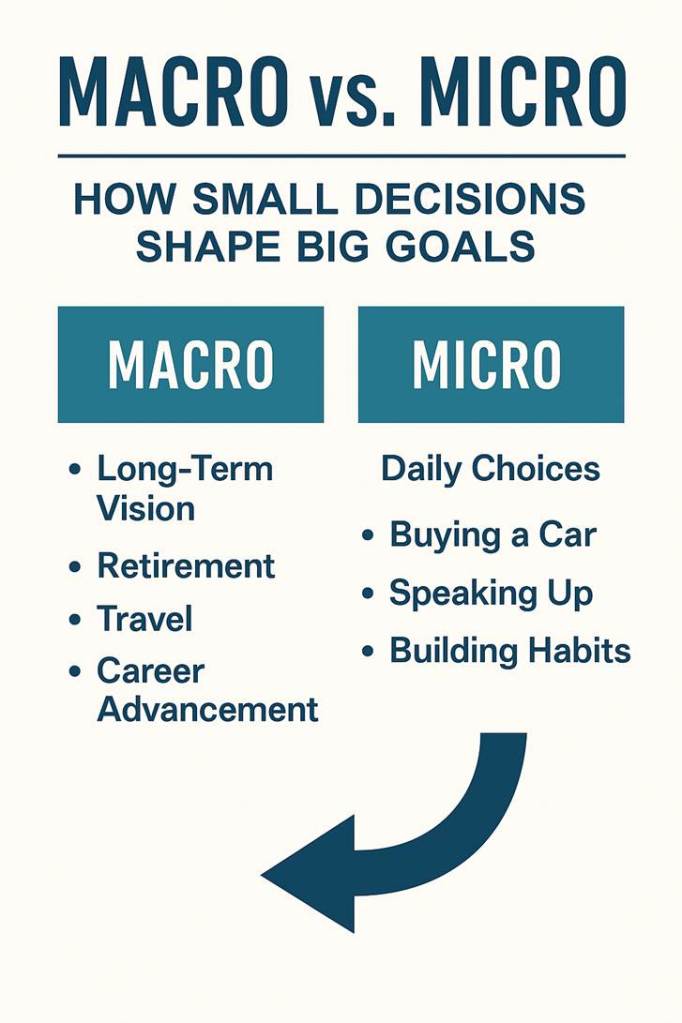
Your macro goals only come to life when your micro decisions support them.


⏳ The Little Things Are the Big Things

Let’s say you have a goal to retire early and travel the world. That’s your macro.

Then comes a moment:
Do I buy the new car I’ve been eyeing, even though mine still runs fine?
It’s a tempting splurge. And maybe, on its own, it’s not going to derail your dream.

But what happens if you make a series of similar decisions?
Each one shaving off potential savings, investments, and freedom down the line?

It’s not just about the car—it’s about the pattern.
The difference between “I can’t afford that trip” and “I’ve been planning for this for years” starts with what we do today.


💼 It Works the Same Way in Your Career

We all want:

  • Growth
  • Recognition
  • Stability
  • Options when it’s time for something new

But those outcomes are earned through consistent micro-actions, like:

  • Showing up with focus even on hard days
  • Volunteering for a project no one else wants
  • Offering help without needing credit
  • Taking feedback and using it
  • Speaking up with intention

When you show up like that, day after day—even when it’s hard—you’re building more than just your résumé.
You’re building your reputation, your influence, and your future leverage.

Those daily actions?
They become the reason you’re trusted with new responsibilities, tapped for promotions, offered flexibility—or empowered to walk away when something no longer serves you.


🔄 What Happens When We Don’t Align?

It’s not just about what we do—it’s about what we don’t do, too.

Sometimes we hold back.
We put off the uncomfortable conversation.
We stay quiet when we should speak up.
We wait for the “perfect time” to apply, pitch, stretch, or lead.

And just like spending money outside our long-term goals—those moments of inaction shift the outcome, one degree at a time.

They may not break everything overnight—but over time, they reroute where we end up.


🧠 So Why Does This Matter?

Because in every post we’ve written here—on resilience, awareness, accountability, reputation, and intentionality—the same truth holds:

The life we build is the sum of how we show up when no one is watching.

And when you align your daily choices with your long-term vision—your growth accelerates.
You don’t just bounce back from setbacks—you move forward with clarity.


✅ How to Align Micro Choices with Macro Goals

Here’s a simple reflection rhythm to stay aligned:

1. Define Your Macro

What are 1–2 major life goals you’re working toward?
Write them down. Keep them visible.

2. Check Your Micro

What decisions are you making daily?
Are your habits supporting or sabotaging those goals?

3. Choose Intentionally

Start with small shifts:

  • Decline the impulse purchase
  • Set a 10-minute buffer before saying yes
  • Speak up in one meeting this week
  • Track your energy, not just your time

4. Reflect Often

Weekly or monthly, check back in:

  • Am I closer to my goals than I was before?
  • Where am I holding back?
  • What’s working?

🧩 Final Thought: You Don’t Need to Be Perfect—Just Present

We’re not here for perfection.
We’re here for alignment. For progress. For awareness.

If you’ve been following along on Authentic Evolution, then you know:
Resilience isn’t just about surviving storms.
It’s about showing up, again and again, with the intention to grow—even when it’s easier not to.

So whatever your big vision is—retirement, freedom, career change, impact—just know:

You are shaping it right now. With this choice. And the next.

Above or Below the Line: How Culture Shapes Accountability and Impact


⚖️ Accountability Isn’t Just Personal—It’s Cultural

If you’ve followed along on this blog, you already know how much I believe in resilient leadership, authentic presence, and leading from within, regardless of title. But there’s another truth that’s just as powerful:

Even the most self-aware, motivated people can get stuck when they’re in a culture that promotes the wrong kind of accountability.

This is where the concept of Above and Below the Line comes in—first introduced in The Oz Principle by Connors, Smith, and Hickman. If you haven’t read it, I highly recommend it. It’s full of exercises and ideas that are especially useful for teams trying to build a culture of trust and ownership.

So what does “Above the Line” really mean?


🔼 Above the Line vs. 🔽 Below the Line

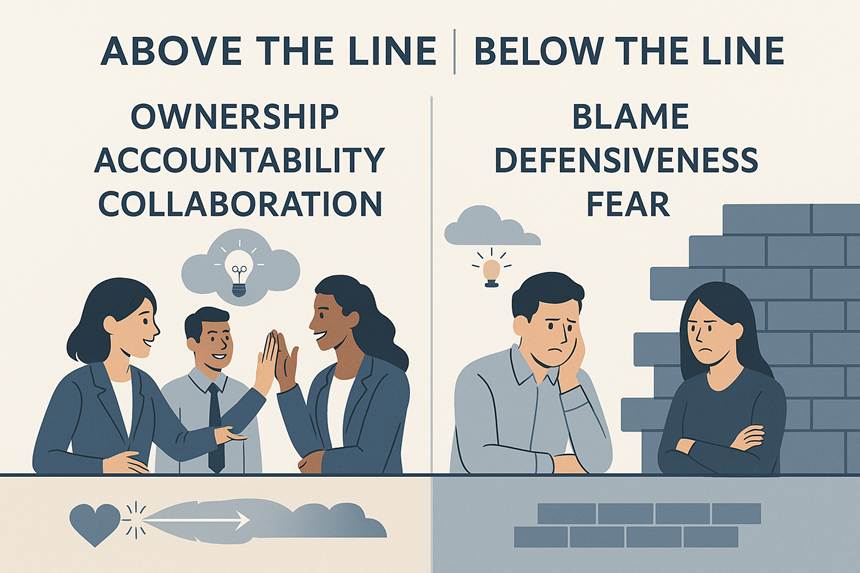
Above the Line accountability is grounded in:

  • Ownership
  • Collaboration
  • Curiosity
  • Solutions
  • Shared responsibility

It’s the kind of environment where people speak up, learn from mistakes, and support each other’s growth.

Below the Line accountability, on the other hand, is rooted in:

  • Blame
  • Defensiveness
  • Fear
  • Covering mistakes
  • Compliance over contribution

This is where innovation stalls, trust erodes, and growth becomes secondary to survival.


👩🏻‍💻 Two Stories, Two Cultures

Let me bring this to life with two real examples from my career:

🟢 The Agile QA Team: Above the Line

In my first role as a Quality Analyst on an agile team, our culture encouraged openness and trust. We were taught to enter defects with as much detail as possible—not to blame, but to help the developers understand the user experience and collaboratively solve the problem.

Performance wasn’t judged on “who got it wrong,” but rather how the team responded, learned, and improved together. That mindset made it safe to speak up and created an environment of shared success. Everyone was motivated to do things the right way—because we were accountable to each other, not afraid of one another.

That’s Above the Line in action.

🔴 The Second Company: Below the Line

Fast forward to a new company. A few weeks in, I found a defect and did what I was trained to do—entered it in the system. What followed? Panic.

“Why would you do that?”
“You don’t report a defect without checking with the developer first!”

It wasn’t just odd—it was shocking. I later learned that developers were rated based on how many defects were opened against them.

Suddenly it made sense. The culture had trained people to protect themselves—not improve the product. Everyone wanted to get it right, but they were also working around the process to avoid being punished for doing the work.

That’s Below the Line. And it breeds fear, resentment, and surface-level compliance.


💬 Why This Matters for Resilient Leaders

We’ve talked throughout this series about:

  • Knowing who you are
  • Building your brand
  • Leading without a title
  • Practicing continual growth
  • Showing up with intention

These personal foundations are what allow us to lead even when the culture isn’t perfect. Because let’s face it—sometimes the storm is bigger than us. But one steady light can start to shift the tide.

When you operate Above the Line, you give others permission to do the same.

Over time, this creates a ripple effect. It inspires team trust. It sets new expectations. It helps change the conversation from “who messed up?” to “how can we make it better together?”


🛠 How to Lead Above the Line (Even When the Culture Isn’t)

  1. Model It Yourself
    Own your part, speak with curiosity, offer solutions—not blame.
  2. Stay Consistent
    Even if others operate defensively, your consistency builds trust and credibility over time.
  3. Acknowledge the Culture—but Don’t Feed It
    If the current culture punishes openness, recognize it—but choose your actions intentionally. Find allies. Start small shifts.
  4. Recognize the Triggers
    Below the Line moments often come from fear. Learn to spot the defensiveness in yourself or others—and ask, “What’s really at stake here?”
  5. Keep Showing Up
    Your presence is powerful. Even in tough spaces, how you show up can be the beginning of something better.

🧩 Final Thought: One Light Can Shift the Room

Culture can either crush accountability—or elevate it. And while you may not be able to change the entire culture overnight, you can change your corner of it.

Your awareness, your actions, your consistency—these are leadership in motion.
And just like resilience, Above the Line leadership is contagious.

So ask yourself:
Am I showing up above or below the line today?
And what ripple could I create by choosing the high road—even when it’s hard?


📚 Resource Mention:
Explore The Oz Principle by Connors, Smith, and Hickman for deeper insight on Above/Below the Line thinking and how to bring it to your team.

Leading Without a Title: Influence Over Authority

Photo by Anna Tarazevich from Pexels: https://www.pexels.com/photo/leadership-lettering-text-on-black-background-5598284/

🌟 Leadership Doesn’t Start With a Title—It Starts With How You Show Up

There’s a long-held belief that to lead, you need the word “manager,” “director,” or “chief” in your title. But if you’ve been following along on Authentic Evolution, you know that’s far from the truth.

Real leadership doesn’t rely on rank. It’s rooted in presence, consistency, and integrity.

And I know this—not just from theory, but from experience.

Before I ever had a title to lean on, I led.
I asked the hard questions, offered help, built trust, and showed up—for the right reasons.
Not for praise, not for promotion, but because it was the right thing to do.
And in time, my voice wasn’t just heard—it was echoed. Because people could count on it to be thoughtful, grounded, and accountable.


💡 The Core of Leadership Is Influence, Not Authority

Here’s what I’ve learned—and what I see in the most impactful people I work with:

  • Influence is earned through trust.
  • Authority can be assigned—but influence must be built.

There have been times, of course, where a difficult internal or external customer didn’t take feedback seriously unless it came from someone “with the right title.” That response says more about them than it does about the person offering the insight. And in those moments, I reminded myself—and others—that leadership is how you engage, not what’s on your business card.


🔍 What Influence Looks Like in Action

You don’t need positional power to lead. Some of the best leaders I’ve ever known were low-level individual contributors—no direct reports, no lofty title—but they had the room.

Here’s how they did it:

  • They showed up prepared.
  • They spoke with clarity and care.
  • They followed through, without chasing credit.
  • They built bridges, not silos.
  • They were trusted—because they were consistent.

Sound familiar? It should. These are the same traits we built throughout the Building Resilience series. And they’re the foundations of real leadership.


🧠 Recognize and Cultivate Your Influence

If you’re wondering whether you’re already leading without the title—you probably are.
But if you want to lean into that more intentionally, here are some ways to grow your influence and amplify your impact:

1. Be Accountable and Consistent

When people know they can count on you—even when it’s uncomfortable or inconvenient—you’re leading. Consistency builds confidence, and confidence creates influence.

2. Be Knowledgeable and Curious

You don’t need to know everything—but you do need to seek understanding. Keep asking, learning, growing. That mindset makes you an asset, and people naturally follow learners who elevate the room.

3. Speak with Intent

Choose your moments to share insight, challenge assumptions, or offer feedback. When your words carry purpose, people pay attention—even if you’re not “in charge.”

4. Offer Solutions, Not Just Observations

Don’t just identify the problem—bring a path forward. Influential people move things, not just point at what’s broken.

5. Support Others Without Needing the Spotlight

Leadership is often most visible when it’s quiet—helping behind the scenes, celebrating others, or staying steady in tough moments.


🔁 Influence Is a Practice—Like Resilience

Everything we’ve explored in the Building Resilience series still applies here:

  • Self-awareness sharpens how you show up.
  • Accountability strengthens your reputation.
  • Support networks echo your voice when you’re not in the room.
  • Consistency becomes your personal brand.

Leadership isn’t something you wait for permission to step into. It’s something you practice until others naturally follow.


🧩 Final Thought: Lead Where You Are

Whether you’re an associate, a developer, an admin, or a VP—you have influence.
And if you focus on building trust, being accountable, and showing up for the right reasons, the title and compensation will come as a reward, not as a requirement.

Because in the end, it’s not about leading because of your title—
It’s about being someone worth following.


The Impact of How We Show Up

💡 Why Showing Up Still Matters

In today’s fast-moving world, one truth holds firm: how you show up matters.

More than ever, people are tempted to do the bare minimum but expect maximum reward. Meanwhile, those who consistently show up with accountability, presence, and intention continue to set themselves apart—not because they’re louder or flashier, but because they are undeniably dependable.

Your reputation, built over time through the small ways you show up, becomes your currency in both personal and professional spaces. And unlike circumstances or titles, it’s one of the few things you can fully own.


🧠 It’s Not Just About Skill—It’s About Presence

Let me share a story.

I had a co-worker—we’ll call him Thomas. He was a senior developer, and honestly, one of the best I’ve ever worked with. Technically gifted, sharp, fast. But Thomas couldn’t understand why others around him were being promoted to manager roles or getting architect titles while he stayed stagnant.

He’d vent about it often.
He wanted more responsibility, more recognition.

But here’s the thing:
Every time Thomas showed up, it was with frustration and negativity.
He’d point out problems, but rarely offer solutions.
His attitude didn’t just cast a shadow—it defined the room.

Even when I gently offered feedback about how to position himself differently—to be seen as a leader, not just a contributor—he couldn’t see it.

Why?

🧩 Awareness + Accountability = Growth

Thomas lacked two key traits:

  • Awareness of how others perceived him.
  • Accountability for how his attitude shaped outcomes.

This is where so many talented professionals get stuck.
Skill matters—but how we show up with that skill is what determines trajectory.


🌟 A Different Example: Quiet Influence, Clear Impact

Contrast that with another associate I worked with—let’s call her Maya.

Maya wasn’t loud or overly polished. But she was always:

  • Present
  • Positive
  • Solution-oriented
  • Willing to help without fanfare

When Maya entered a room, people leaned in. When she didn’t show up with her usual optimism, people took notice—because it meant something.

Her consistency made her a beacon for the team. Her reputation wasn’t built by one big moment—it was shaped by how she showed up, day after day, even when it was hard.


🔄 Repetition Builds Reputation

If you’ve followed the Building Resilience series here on Authentic Evolution, you’ve probably noticed a common thread:

Resilience isn’t just about bouncing back—it’s about showing up with intention, again and again.

And showing up is where reputation meets resilience. It includes:

  • Your energy
  • Your words
  • Your follow-through
  • Your presence
  • Your ability to read the room—and lead it

🧠 Questions to Reflect On

If you want to grow your impact, start by asking yourself:

  • How do I want people to feel when I show up?
  • Do I offer solutions—or just surface problems?
  • Am I consistent in my energy and accountability?
  • How would I describe my reputation—and does it match how others would?

🛠 Final Thought: You Are Already Showing Up—Make It Count

Here’s the truth: we’re always showing up. Even silence is a signal.
Even disengagement sends a message.

So make yours intentional.
Let your presence reflect your purpose.
Let your reputation be the echo of your values.

Because in a world full of shortcuts, your consistency, clarity, and character will set you apart—and open doors long before you ask for them.

How to Bounce Back: Embracing Resilience Wisely

In the previous series Building Resilience: Navigating life’s curveballs, we talked about the building blocks that can help us become resilient… that is great in theory, but when the tough stuff happens… how do we start? How do we bounce back?

🌀 Before You Bounce Back, Breathe

Let’s be real—resilience is not a superhero cape.
It’s not a stoic silence.
And it’s definitely not pushing past pain with a smile on your face.

In the aftermath of a setback—whether personal or professional—there’s a sacred space that often gets overlooked. It’s the pause between the fall and the rise. The moment you feel, before you forge ahead.

That’s where “The Bounce back” begins.


🧠 We’re Human, Not Machines

The resilience we’ve been building together—through knowing ourselves, embracing discomfort, cultivating support, enabling reputation, and practicing continual growth—is rooted in self-awareness. And self-awareness starts with acknowledging how we feel when things go sideways.

Sad.
Frustrated.
Angry.
Embarrassed.
Disappointed.
Empty.
Tired.

You’re allowed to feel it all. In fact, you must.

“Emotions aren’t the opposite of resilience—they are the entry point to authentic recovery.”


🧩 This Isn’t Weakness—It’s a Step in the Process

Too often, we skip the emotional processing because we think strong people “move on quickly.” But the reality is:

  • Suppressed emotions come out sideways.
  • Ignored grief becomes burnout.
  • Untended frustration becomes resentment.

In your personal evolution, there’s no badge for “moving on” before you’re ready. The real strength is in naming what you feel, holding space for it, and then moving forward intentionally.


🔄 Bounce back ≠ Return to the Old

Let’s also redefine what “bounceback” really means.

It’s not about snapping back to how things were before.
It’s about integrating what you’ve learned, processing how you’ve changed, and bouncing forward—with more wisdom, more clarity, and more strength.

Bounce back looks like:

  • A clearer boundary.
  • A reevaluation of what matters.
  • A recommitment to your values.
  • A decision to pivot, rest, or rise differently.

💬 How to Hold the Emotion + Reclaim Your Energy

Here’s how we honor the human moment and rebuild with intention:

1. Pause and Name It

Take 10 quiet minutes. No agenda. No problem-solving. Just name what you’re feeling.

2. Let Someone In

Talk to a trusted friend or mentor from your support network (remember Part 3?). Let them witness your process. You don’t have to bounce back alone.

3. Extract the Insight

What does this moment reveal about your boundaries, expectations, or values? Use your Values Alignment Check or revisit your Mission Statement (from Part 5).

4. Plan Your Re-Entry

Once the emotion has been held and heard, ask yourself:

  • What’s one small step I can take today?
  • What do I want to do differently moving forward?

🌱 Final Thought: The Bounce back Is the Becoming

Every time you bounce back, you are reshaped. Not back to who you were—but forward into who you’re becoming.

At Authentic Evolution, we don’t believe in glossing over the hard stuff. We believe in feeling, facing, and evolving—through it. And if you’ve followed along through the Building Resilience series, then you already know: the tools are in you. Your network is around you. Your wisdom is waiting.

Take your breath.
Feel what you need.
Then bounce back—not as a reflex, but as a resilient response.